Brevard County trauma survivors reunite with first responders, medical teams at Health First’s 4th annual Trauma Survivor Reunion.
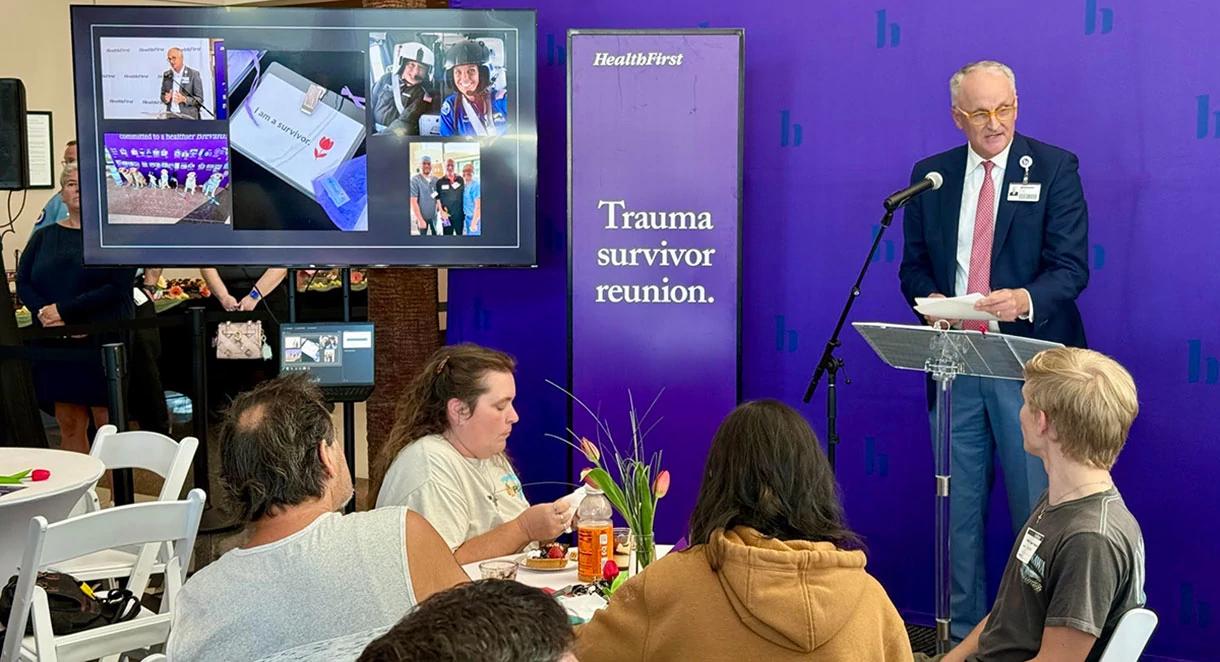
Terry Forde, CEO and president of Health First, delivered opening remarks at the fourth annual trauma survivors celebration held at Holmes Regional Medical Center.
Health First’s Holmes Regional Medical Center hosted its fourth annual Trauma Patient Survivor Reunion on Wednesday, May 20, an emotional and inspirational event celebrating trauma survivors, their loved ones, and the care teams who helped save their lives.
Over a dozen survivors, including vehicle, boating, and motorcycle accident victims, were among those in attendance and reunited with surgeons and clinical teams, as well as EMS responders and Health First’s First Flight air ambulance crewmembers.
The event also fell on National Trauma Survivors Day, a day recognized every year on the third Wednesday of May to celebrate together the strength and resiliency of trauma survivors, their family/friends, and the trauma professionals who go above and beyond every day.
“Each day, I am inspired by the strong sense of connection that defines this organization and the community we serve,” said Health First President and CEO Terry Forde.
“Here on the Space Coast, people show up for each other. And perhaps nowhere is that care so clearly demonstrated as in the connection between trauma patients, their loved ones, and the healthcare providers dedicated to their recovery. Tonight’s event celebrates the power of courage and possibility.”
“It is an honor to celebrate your journeys and to recognize your courage,” Forde continued. “Our trauma team shows up to work each day and night inspired by a powerful mission—helping patients return to their families, their homes, and their lives.
Forde touched on some of Health First’s injury prevention initiatives. Dr. Christina Sebastian, trauma surgeon, said the team is always prepared for anything. Because even with the strongest prevention measures, traumatic accidents and emergency situations unfortunately still happen.
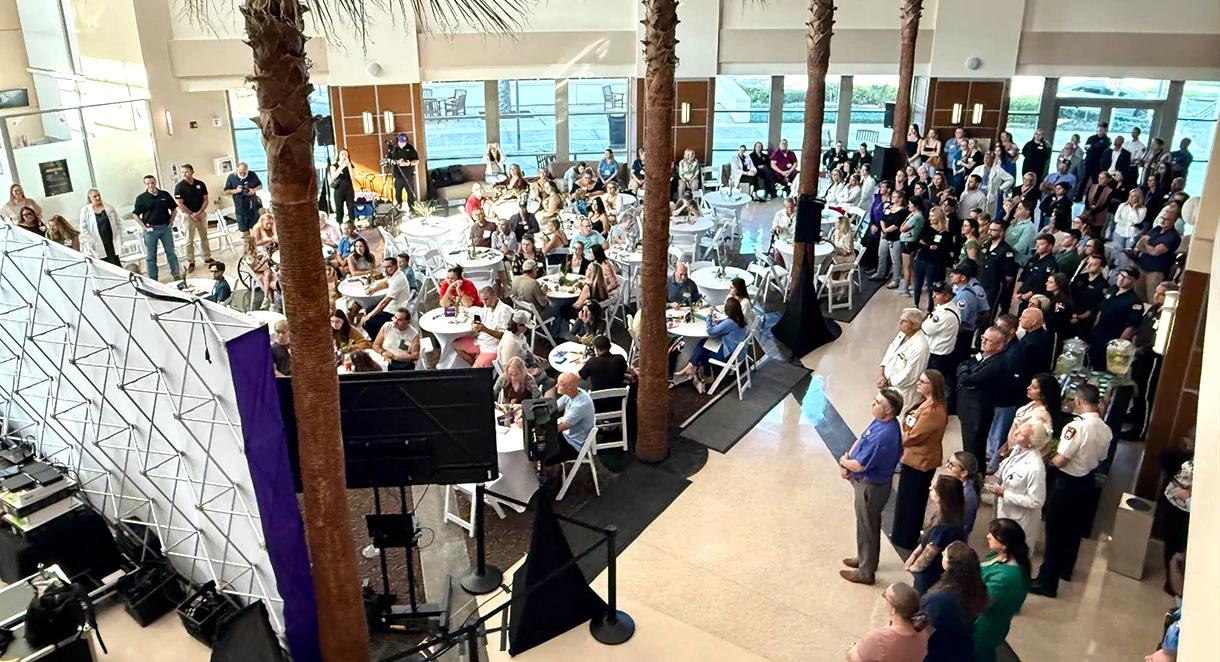
EMS personnel, doctors, nurses, speech therapists, physical therapists, families, and many others filled the atrium at Holmes Regional Medical Center for the fourth annual trauma survivors’ celebration hosted by Health First.
“We all saw that reality firsthand last week when a plane carrying 11 passengers crashed into the Atlantic Ocean 80 miles off the Space Coast,” Sebastian said. “For five hours, these survivors battled to stay afloat in the open water, hoping that help would arrive. And it did, thanks to the 920th Rescue Wing at Patrick Space Force Base. Following their heroic air rescue, 10 survivors were transported to us at Holmes, where our trauma team began assessing their condition as soon as they arrived.”
When it comes to trauma and emergency medicine, drills are run on a regular basis.
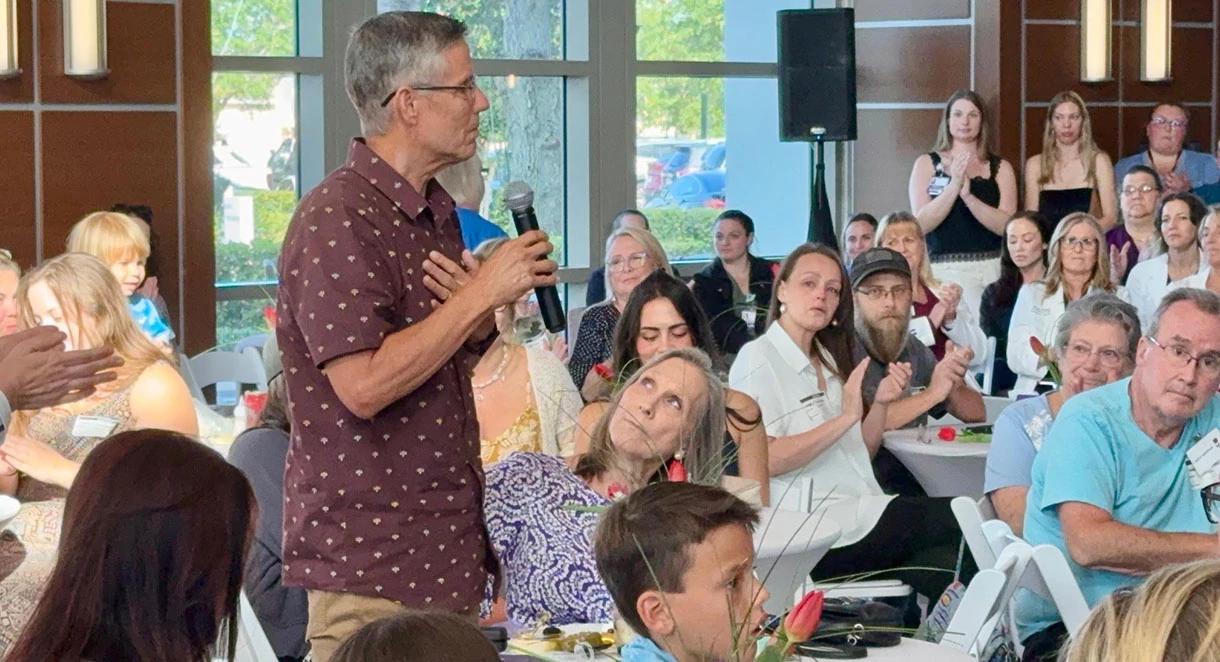
Keith Arbuckle was among one of many trauma survivors in attendance, celebrating his continued recovery. He offered a heartfelt and emotional tribute to the doctors and staff who cared for him following a traumatic cycling accident.
Care teams routinely prep for all types of critical situations, especially those in which multiple trauma patients may be arriving simultaneously with a wide range of injuries and care needs.
“We do this crucial training precisely for scenarios like this, so we’re ready to treat every patient who comes through our doors with the right care, the right way,” Sebastian said. “Last year, the Health First Trauma team treated 2,745 trauma patients, and that number is growing every year. That’s why it’s essential to have a highly coordinated and skilled trauma team. Our trauma surgeons, advanced practitioners, nurses, therapists and First Flight helicopter crews work tirelessly to provide rapid, exceptional and compassionate care.”
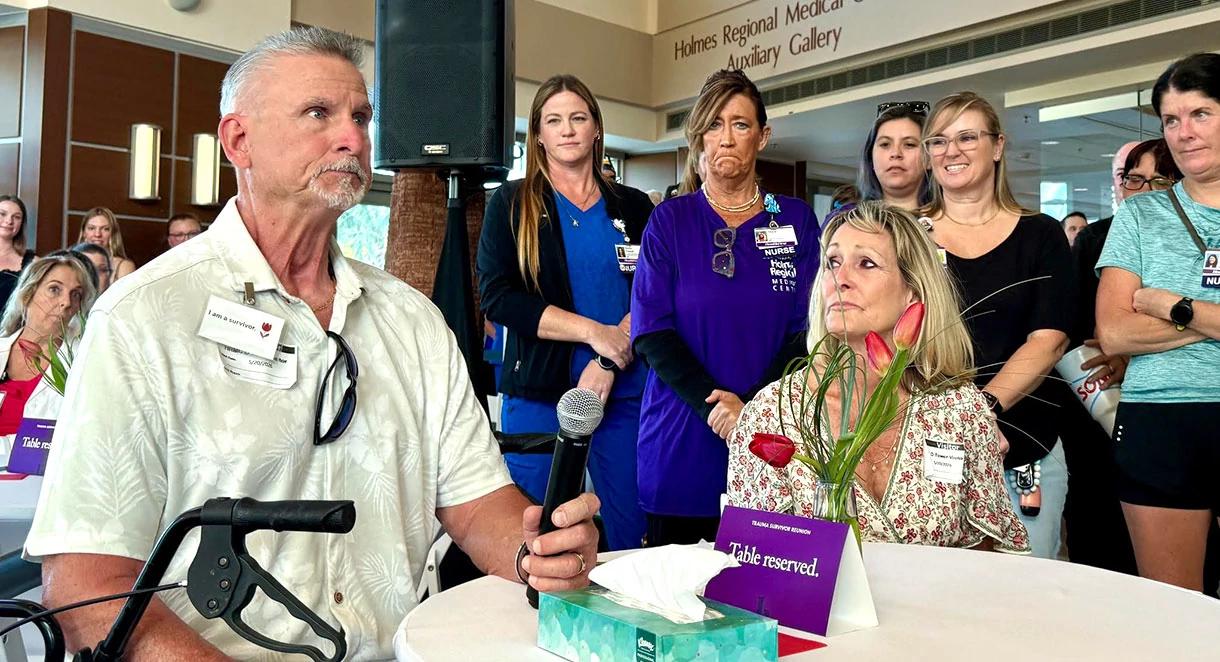
Mark Kramer attended the trauma survivor’s celebration at Holmes Regional Medical Center, where he became emotional while thanking his entire care team for the treatment and support he received after an e-bike accident that left him with no memory of the crash.
Some of this evening’s survivors and their stories include:
Mark Kramer, 61, of Sebastian, was injured Sept. 26, 2025, in an e‑bike crash. Police officers were first on the scene and performed CPR. Although he has no memory of the incident, witness accounts described him losing control and colliding with a parked car on a residential road.
Kramer said he was told he was “dead on the scene” before being revived and transported to Health First’s Holmes Regional Medical Center, where he spent more than a month recovering. His recovery involved significant physical challenges, including limited mobility on his right side, but he has progressed to walking with a cane and is continuing therapy.
“I do not remember most of that day at all. I was riding a new e-bike I had for only 20 days. The handlebar was shaking; the front wheel was shaking and I had no control over that vehicle. I ended up going headfirst into a parked car. This e-bike is ridiculous, because it could get up to 40 miles per hour. I was actually dead on the scene; I think they call it ‘coded.’ Next thing I know, I’m in the hospital all wired up… it was very surreal,” said Kramer.
What stays with Kramer is that he was simply out getting some exercise — and doing what he loved.
“I’m not jumping out of an airplane,” Kramer said. “I’m not wrestling alligators; I’m not a stunt guy. I just went out to ride my bike.”
What stays with Kramer is that he was simply out getting some exercise — and doing what he loved.
Keith Arbuckle 63, of Palm Bay is a longtime cyclist and software engineer. He survived two separate bike accidents in 2023 — the second leaving him with a traumatic brain injury, vision loss and no memory of his early hospitalization.
The second crash happened when Arbuckle struck a dropped water bottle from a cyclist ahead of him, sending him over the handlebars and causing a severe head injury. The accident happened during a group cycling session, when Arbuckle was headed north on U.S. 1.
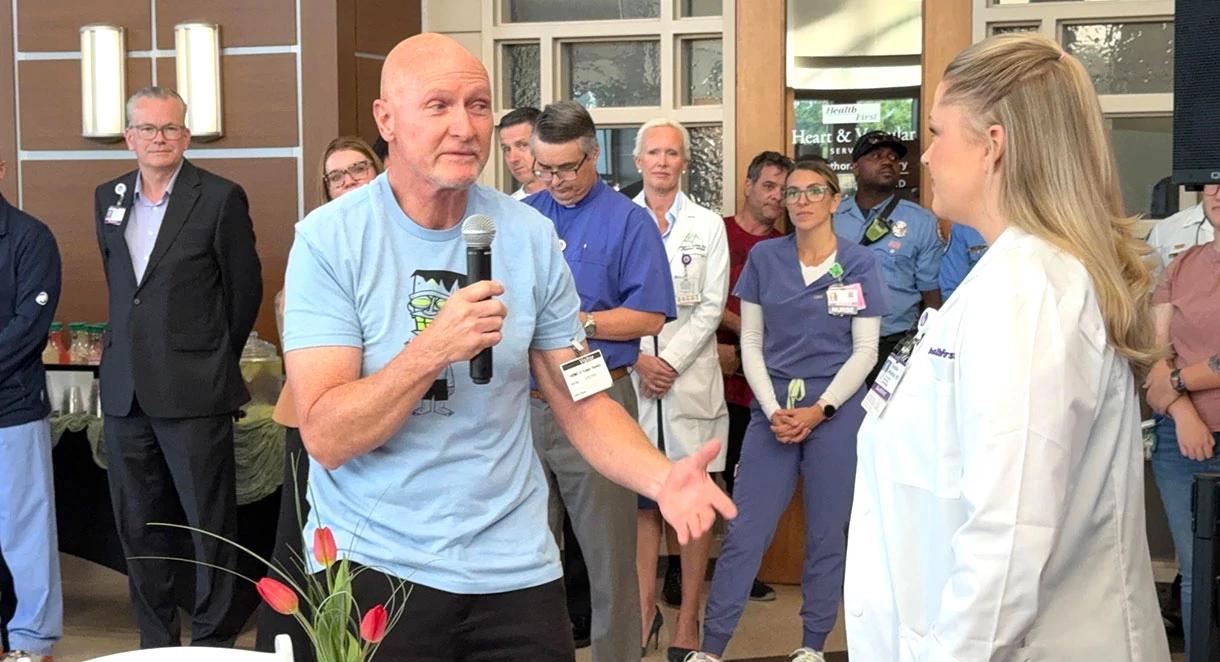
After what Donnie Ray Rife called a “life changing event”, he joined over 20 other trauma survivors at the trauma survivor at celebration at Holmes Regional Medical Center where they made connections with other survivors and spoke about their journey of healing.
He was airlifted by First Flight to Holmes Regional for care and later transferred for specialized rehab at Brooks Rehabilitation in Jacksonville, with only faint memories returning weeks later.
During that time, much of what Arbuckle understands about his care comes from his wife — who remembers the constant presence of physicians and caregivers. That consistent presence gave reassurance during a time he himself can’t recall. His wife, Ruth Ann, remembers it all, though.
Recovery was long and humbling. Arbuckle had to relearn basic functions, from walking to reading, relying heavily on his wife, who worked with him daily to rebuild his vision and independence. Today, he has returned to work but continues to live with lasting effects, including memory challenges and vision loss that prevent him from driving.
“My memory is not what it used to be — I can’t remember people’s names,” Arbuckle said. “That’s my biggest struggle. At first, every day felt new or different. Just being able to walk around the block was a big deal.”
Arbuckle had been a cyclist since his 20s and was heavily involved in it. Now, he notes the irony: “Something that I love doing has done this to me and I almost lost my life because of it.”
Arbuckle credits his wife as a huge blessing in his recovery. He and his wife also are thankful for the thoughtfulness of Dr. Jarom Hanson, a neurologist, who came by Arbuckle’s room daily — even on his days off — to check in on him, as well as his wife, who appreciated his regular presence.
“He was there every single day, even though he wasn’t my doctor,” Arbuckle added.
The experience has taught Arbuckle to be thankful for what he has.
“I’m so appreciative,” Arbuckle said.
Donnie Ray Rife, 65, of Indian Harbour Beach is a longtime competitive motorcross rider. Rife was seriously injured in a mountain biking accident July 20, 2025, on the Grapefruit Trail in Palm Bay and has limited memory of the event. He only recalls being airlifted by Health First’s First Flight before losing consciousness. He sustained significant injuries that initially left him unable to walk and without use of his left arm, requiring intensive care and rehabilitation.
Rife credits his recovery to his care team, rehabilitation and support from his wife, describing the hospital team as constantly present and attentive.
Despite being told early on that his condition “doesn’t look good,” he has made what he describes as a “miraculous recovery,” regaining mobility and independence.
“The accident was life changing. I mean, I’ll never be the same. You can easily mentally go to a very dark place. Life is short. You leave the house one day — you may not come back,” Rife said.
“Never give up,” Rife said. “I mean, they originally told my family, ‘It doesn’t look good.’ I tore both the vertebral arteries, too, in my neck. I was bleeding out. Considering what trauma I experienced, people are like, ‘I can’t believe this guy’s walking.’ I put my faith in God, and have a closer relationship now, for sure.”
According to the American Association for the Surgery of Trauma (AAST), injury is considered a major public health problem. In the United States, injuries account for over 150,000 deaths and over 3 million non-fatal injuries per year. Around the world, injury is responsible for more than 5 million deaths per year. Many millions more are injured. The events that result in injury are not random or unpredictable. Injury can be prevented and many lives saved by learning more about the causes of injury and implementing appropriate injury prevention strategies. Many of these strategies are well-established, easily available and relatively inexpensive, such as seat belts and helmets.
Health First’s First Flight air medical program operates two state-of-the-art EC135 helicopters, equipped with critical care interiors tailored for Emergency Medical Services (EMS) and interfacility hospital transport. Both helicopters are staffed with highly trained professionals — including one pilot and two medical crew members: a Registered Nurse Paramedic (RN Paramedic) and a Critical Care Paramedic.
First Flight has served as the primary helicopter ambulance service for Brevard County and northern Indian River County for over 35 years, responding to multiple calls each day. As the number of calls have increased, Health First doubled its air fleet to meet the anticipated growth of emergency and trauma needs.
With the influx of aerospace and defense employment, and one of the nation’s busiest commercial cruise ports, Brevard, the 10th largest county in the state of Florida, is expected to continue its growth and development.
“In a traumatic emergency situation, such as vehicle crash, a workplace injury, a heart attack or stroke incident, time matters – time is life,” said Tiffany Bassani, Health First director of patient logistics.
“Being able to reach, stabilize and quickly transport a patient to the nearest medical center gives the patient the very best chance of survival and this expanded air presence now provides the fastest, most saturated coverage Brevard County has ever had. And with four hospitals in Brevard County including Cape Canaveral in the north, Viera and our Level II trauma center Holmes Regional Medical Center in Central Brevard, and Palm Bay Hospital in south Brevard, our strategically placed First Flight presence can quickly reach and transport a patient in less than 30 minutes anywhere in the county,” continued Bassani.
First Flight operates out of two strategic bases of operations: one in Melbourne at the Melbourne Orlando International Airport — and in Titusville, enabling the air teams to effectively support a wide range of emergencies, including trauma, cardiac, stroke and other acute medical conditions.
In partnership with Metro Aviation, First Flight benefits from 43 years of expertise in medical aviation operations.
Health First and Metro Aviation have been working together for over 33 years, combining efforts to provide seamless and life-saving air medical services.
Health First in the news.
Stay informed about the latest at Health First, from new technology to groundbreaking procedures and more.


