READY FOR THE WORST CASE: Health First Partners With Multiple Brevard First Responder Agencies on Live Trauma/Disaster Drill
Mock drill strengthens response of Brevard medics, their leaders and hospital physicians
WATCH: Health First conducted its semi-annual mock emergency/disaster training drill involving Health First emergency and trauma clinical teams, and multiple Brevard County Emergency Medical Service teams on Friday, Nov. 14. (Health First video)
A semi-annual mock emergency training exercise featured lifelike patient simulators… and a new “active crime scene” component.
On a brilliant, bright blue early fall morning, (controlled) chaos began to unfold in an open field midway between the Atlantic Ocean and Health First’s Cape Canaveral Hospital in Cocoa Beach.
Health First conducted its semi-annual mock emergency/disaster training drill involving Health First emergency and trauma clinical teams, and multiple Brevard County Emergency Medical Service teams on Friday, Nov. 14.
The drill, designed to simulate a traumatic mass casualty emergency event, included overturned vehicles, multiple medical attention scenarios, accident trauma “victims,” and the arrival and utilization of a First Flight medical helicopter.
Health First’s First Flight air ambulance team, Cocoa Beach Fire Department, Cape Canaveral Fire Department, the Cocoa Beach Police Department and Coastal Health Systems of Brevard ambulance crews all worked in tandem for the live-action drill.
The live action simulation provided EMS and trauma care providers an opportunity to review their own protocols and offer feedback on their performance during such a high-stress, life-or-death event.
Exercises like mock drills strengthen the response of Brevard County medics, their leaders, and hospital physicians. Simulations provide an opportunity to reflect on and assess the emergency responses, pre-hospital intervention, and trauma care in Brevard.
The collaboration also fosters positive relationships between first responders and trauma caregivers, explained Health First’s Dr. Larissa Dudley, EMS medical director for First Flight, Cape Canaveral Fire Department, and Cocoa Beach Fire Department.
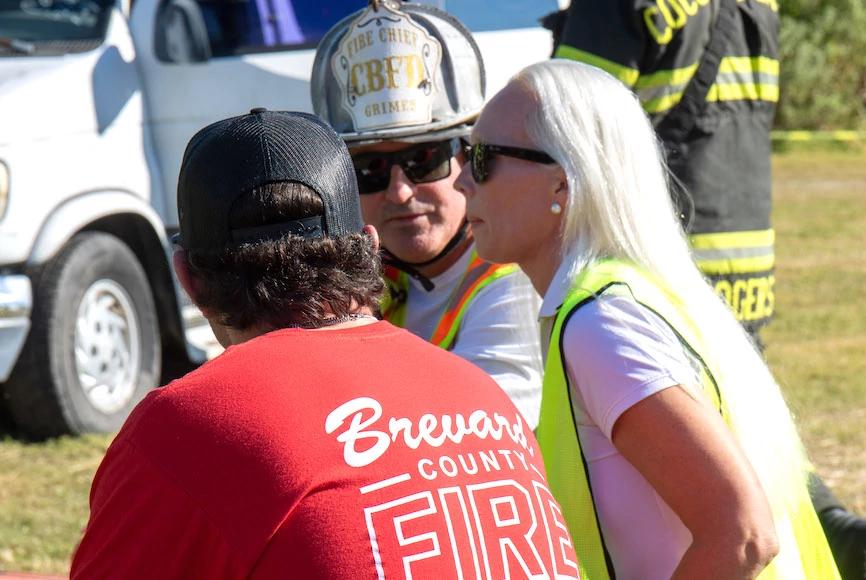
“Today we’re drilling with multiple agencies to practice extrication, patient management, and really go over those types of scenarios where the needs outweigh the resources that we might have available in a real situation. This collaboration between our departments allows us to closely work together to practice going through these movements, using their equipment, going through medical training, and then to be able to bring in the police department to practice their crime scene investigation is really an important goal for today,” said Dudley.
“Our county is such an interesting, unique county landscape. It’s so long, but although it’s relatively narrow, there’s so many different aspects to the county between the space program, three rivers, the Atlantic Ocean (with us being in Cocoa Beach today) a major Interstate, and the county is also heavily forested. In addition to the 650,000 residents in Brevard, we have the cruise ships that come in, an influx of visitors, vacationers, passers-through, Brightline running up our coast. Between these agencies here together, we have to work together in order to get the patients out of their emergent condition and to the hospitals so that they can be treated quickly and thoroughly, Dudley continued.
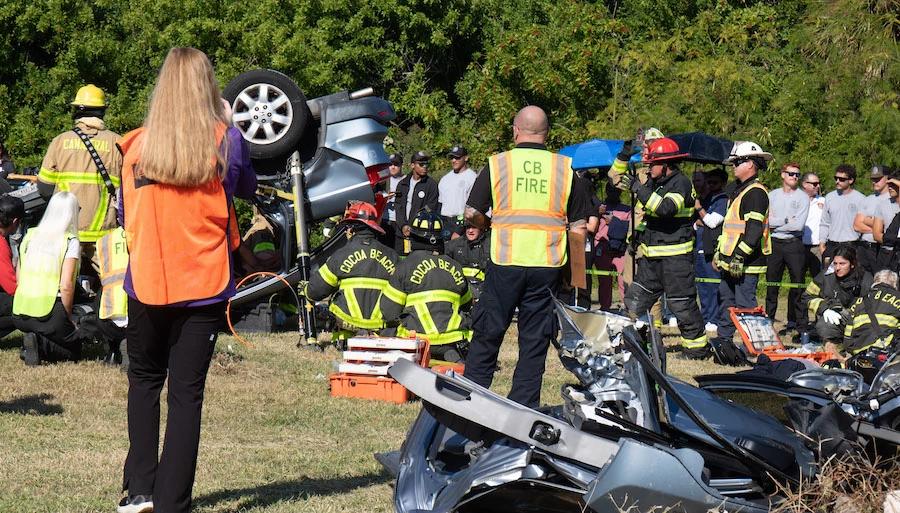
Multiple agencies from around Brevard County participated in a Trauma Mock Drill in Cocoa Beach Nov. 14. Jessica Hendwood, Trauma Clinical Outreach Coordinator/Injury Prevention at Holmes Regional Medical Center, looks on while assessing the simulated trauma scenarios.
Staged overturned vehicles were in place as well as actors from Eastern Florida State College to create lifelike training scenarios, and as a new component to the training modules, the Cocoa Beach Police Department conducted a simulated homicide crime scene investigation as part of the trauma drill.
The training exercise also included the use of two high-tech patient simulators, including Health First’s “Trauma HAL.”
Purchased with a grant from the Health First Foundation, “Trauma HAL” is specifically engineered to meet the training needs of first responders, EMS, and in-hospital emergency teams. Trauma HAL helps teams engage in true-to-life training exercises to improve emergency preparedness, response, and patient care.
It is a technologically advanced patient simulator that has true-to-life anatomy and physiology and can simulate everything from strokes to gunshot wounds. A tablet-based system allows different scenarios to be programmed and controlled on the scene and provides event recording and can export performance reports for debriefing.
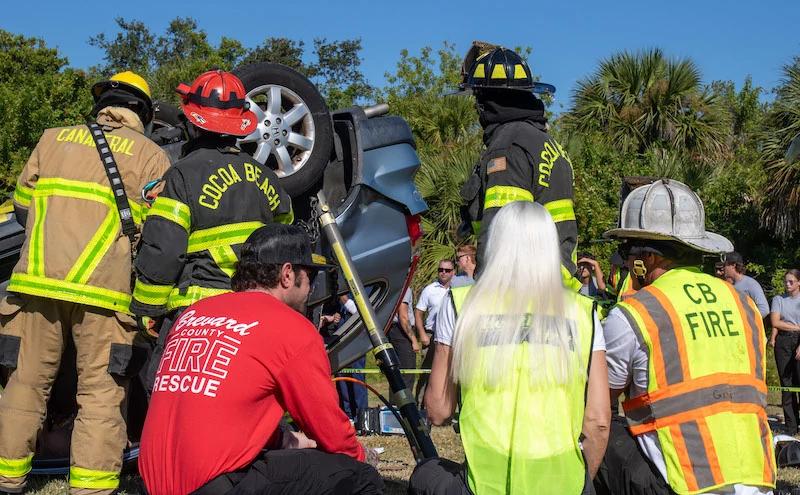
With multiple scenarios underway during the multi-agency trauma mock drill, Dr. Larissa Dudley, M.D., Health First’s First Flight EMS Medical Director, gets close to the scene alongside first responders to discuss the unfolding training situation.
In addition, EMS and trauma care clinicians reviewed protocols and provided performance feedback to participants at the conclusion of the re-enactment geared toward the continual improvement of emergency response, pre-hospital intervention and trauma care in Brevard County.
Among the many organizations participating today, there were also many “observers”, including faculty and students from the Burrell College of Osteopathic Medicine.
Dr. Doris Newman, D.O., FAAO, Dean of trauma, was on hand with a group of students and faculty as observers, with the hope of soon becoming active participants in the drills.
“We’ve been in Melbourne for two years now. And behind me are some of our faculty and our second-year medical students who are very eager to observe the mass casualty incident. Our students are very excited to soon be able to participate with Health First and the other agencies on one of these drills. But today is a great opportunity to just observe and see how things are done,” said Newman.
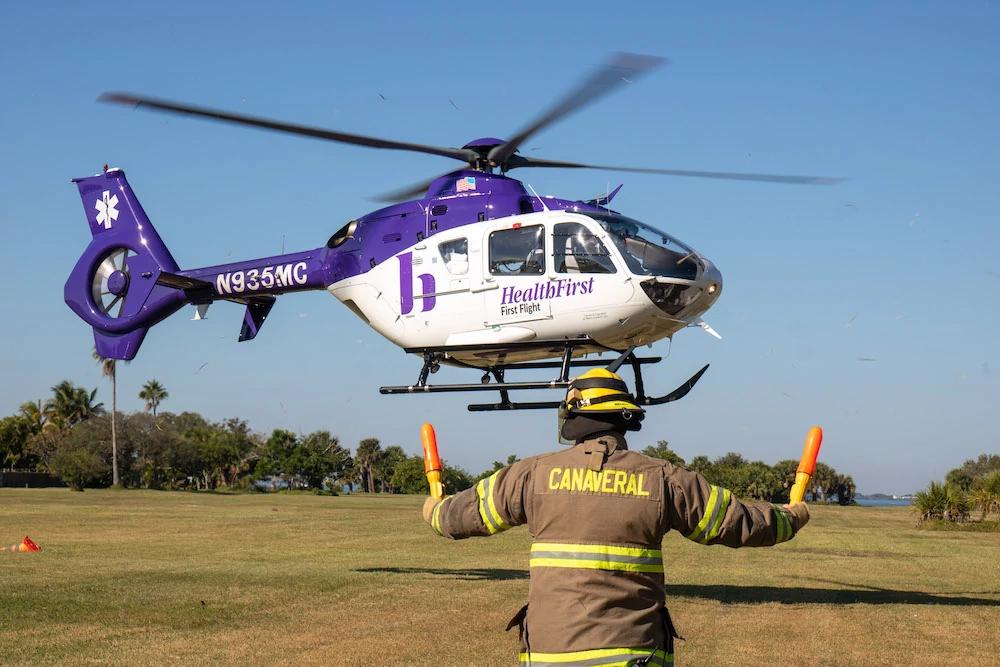
Health First’s First Flight lands in Cocoa Beach as part of a full-scale, multi-agency trauma mock drill, supporting first responders during the coordinated emergency response exercise. (Health First image)
Heading into its third year in Melbourne at the Florida Institute of Technology campus, Newman said the program has been very successful and continues to grow.
“We’ve really enjoyed our relationship with Health First. We now have our third-year medical students learning hands-on at Health First for the second year in a row – and that partnership will only continue to grow.”
Michael Yingst, a student doctor and board president of the medical class at Burrell College, said live mass casualty drills are an invaluable learning experience.
“We’re hoping to see some different ideas of how mass casualty incidents can be employed and how maybe some student physicians can be involved at a future time and just see how everything matches together – and then apply what we’re learning in class into the real-life scenario. So, this is in-depth. This is real-world training.
“There’s a number of us here today who have had some prior life experiences. I’m hoping to just see how things end up actually being employed in practice and the kind of exercise scenarios that play out, because you never know how these sorts of things happen in real life – and they kind of just happen on a dime,” Yingst continued.
Health First in the news.
Stay informed about the latest at Health First, from new technology to groundbreaking procedures and more.


