Health First Cardiologist Dr. Kevin Campbell Delivers Life-Saving Advice to Members of GFWC Space Coast Women’s Club
Women Learn How to Protect Their Hearts in February
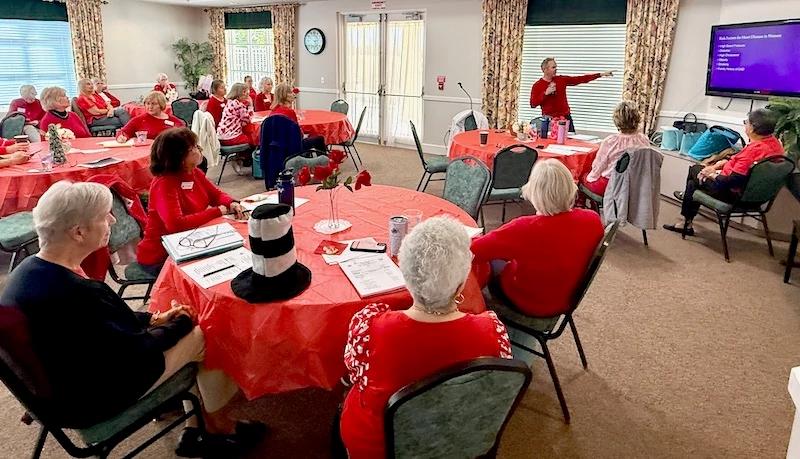
Health First cardiologist Dr. Kevin Campbell speaks to members of the GFWC Space Coast Women’s Club
during a Heart Month presentation at the Viera East Residence Clubhouse, focusing on women’s
heart health and disease prevention.
Dressed in red in support of Heart Month, members of the General Federation of Women’s Clubs (GFWC) Space Coast Women’s Club gathered at the Viera East Residence Clubhouse as Dr. Kevin Campbell, MD, FACC, MBA, CPE, arrived with a clear goal.
As February marks American Heart Month, Campbell was there on behalf of Health First to speak directly to women about heart disease, the leading cause of death among women in the United States.
Campbell, a cardiologist with Health First and Chair of Medicine at Viera Hospital, has made women’s heart health a central focus of his work. Through patient care, education and community outreach, he is working to close the awareness gap that continues to put women at risk.
He has published a book on the subject entitled “Women and Cardiovascular Disease: Addressing Disparities in Care,” and his talk to the GFWC Space Coast Women’s Club was part of that ongoing effort to meet women where they are and provide clear, practical information that can save lives.
The GFWC Space Coast Women’s Club is a nonprofit organization focused on community service and education, making Heart Month a natural time to turn attention to women’s heart health. With boots on the ground supporting organizations throughout the community, the gathering offered members an opportunity to pause and focus on their own heart health.


<h3 class="heading style--heading3">Heart-themed treats reflected the spirit of American Heart Month during the GFWC Space Coast Women’s Club event featuring Health First cardiologist Dr. Kevin Campbell.</h3>
Each year, more than 350,000 women die from heart disease, accounting for one out of every five female deaths. Heart disease claims more lives in women than all cancers, Alzheimer’s disease and accidents combined.
Despite these statistics, many women still do not recognize heart disease as their greatest health risk.
“One of the biggest challenges is that heart disease in women often looks different than it does in men,” Campbell said.
While chest pain and shortness of breath can occur, women are more likely to experience symptoms such as fatigue, nausea, sweating, anxiety, flu-like feelings, jaw or neck discomfort, or an unexplained sense that something is not right.
“These symptoms can be vague and easy to dismiss,” Campbell said. “Women may downplay them, and sometimes they are even overlooked in healthcare settings. That can delay diagnosis and treatment.”
Campbell also addressed the historical and systemic factors that have contributed to gaps in care. Heart disease in women often involves smaller blood vessels and more diffuse disease, making it harder to detect with traditional testing.
For decades, heart disease was viewed primarily as a men’s health issue, a perception that continues to influence awareness, screening and treatment.

<h3 class="heading style--heading3">Dr. Kevin Campbell, a cardiologist with Health First and Chair of Medicine at Viera Hospital, has made women’s heart health a central focus of his work. Through patient care, education, and community outreach, he is working to close the awareness gap that continues to put women at risk.</h3>
Through Health First, Campbell works to change that narrative by combining advanced diagnostics, patient-centered care and education. He emphasized that heart disease is often preventable and that understanding personal risk factors is key. High blood pressure, diabetes, cholesterol levels, smoking, obesity, and family history all play a role.
Lifestyle choices matter as well. Regular physical activity, a heart-healthy diet, stress management and carving out even ten minutes a day for personal health can significantly reduce risk.
When asked what Heart Month meant to her personally, Post offered a simple but powerful takeaway. “Exercise more,” she said.
Campbell encouraged women to advocate for themselves and for one another. Choosing a healthcare provider who listens, takes concerns seriously and considers heart disease even when symptoms are subtle can make a life-saving difference.
“Talk openly with your friends, family, and fellow club members about women’s heart health,” Campbell said. “Awareness spreads quickly in strong communities like this one, and it saves lives.”
For Health First, community education is an extension of care. By stepping outside the hospital and into neighborhood clubhouses, Campbell and other physicians are helping ensure that critical health messages reach the people who need them most.
Health First in the news.
Stay informed about the latest at Health First, from new technology to groundbreaking procedures and more.


